Long Before
Before jeans and shirts, before suits and trousers — India had the dhoti.
Simple yet dignified, the dhoti is not just a garment; it’s a symbol of our tradition and culture. From sages and scholars to kings and freedom fighters, the dhoti has been worn with pride for thousands of years.
Let’s explore the origin, evolution, and cultural importance of this timeless attire.
The Ancient Beginning
The history of dhoti traces back over 5,000 years, to the Indus Valley Civilization (around 2500 BCE).
Excavations and ancient sculptures show men wearing a long rectangular cloth wrapped around the waist — this early version of the dhoti was the foundation of Indian traditional dressing.
It was comfortable, natural, and suited perfectly to India’s hot and humid climate.
“The dhoti is not a trend — it’s a timeless tradition that has lived through every era.”
What is Dhoti ?
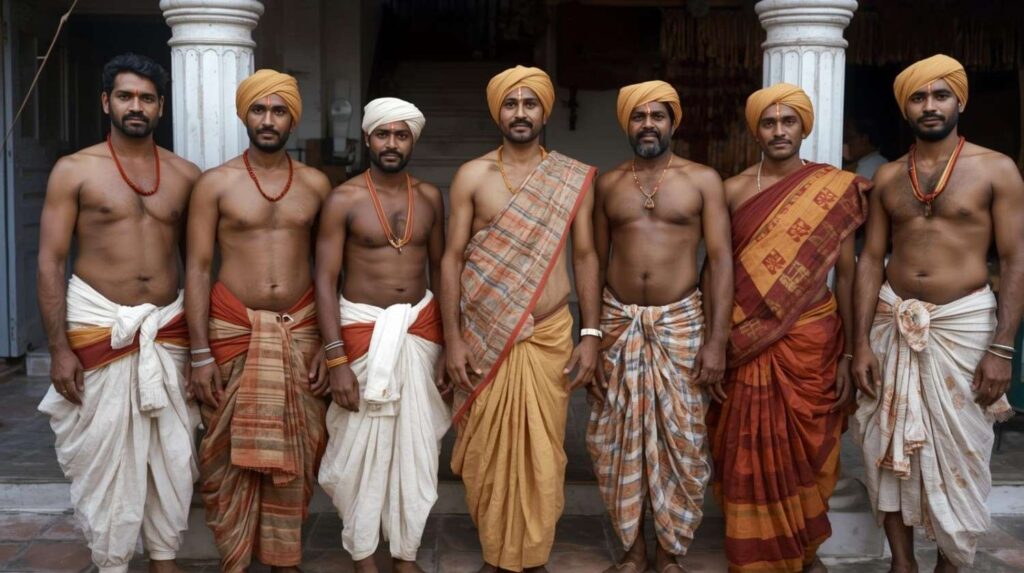
Dhoti is the traditional attire of Indian men. The styles and attitudes of dhoti wearers change depending on the state or province. The presence of dhotis can be felt prevalently in various functions and proceedings.
Origin and History of Dhoti
Dhoti is a word that originated from the Sanskrit word Dhauta. It was also marked as the traditional wear by several leading Indian politicians across the Indian subcontinent. Initially, it was worn only with a kurta. The dhoti was also considered to be an attire that commanded respect and dignity.
Dhoti In Vedic Times
In the Vedic period, the dhoti was known as “Vastra” or “Antariya.”
Men wore it for both daily life and religious rituals, symbolizing purity and simplicity.
Even today, wearing a dhoti during spiritual ceremonies represents devotion and discipline — a tradition that has continued unbroken for thousands of years.
Diffrent Styles of Dhoti
Dhoti is available predominantly in white and cream colors. The material for this fabric is cotton. In most regions of the south, it is mostly made using a gold border. Mostly, 5 yard long strips of cloth are used to make dhotis. Approximately five knots are used to wrap this garment. The style of wearing differs in every land.
Innovation in dhoti
A lot of innovation has passed the world of the dhoti. What was considered once considered traditional wear in various circles of society, several western improvisations have given dhoti a whole different style known as dhoti pants which have the structure of dhoti combined with western pants. This is a beautiful innovation worn by both men and women.
Symbol of Simplicity and Strength
During India’s freedom struggle, the dhoti became a symbol of national pride.
Mahatma Gandhi famously wore the dhoti as a stand against British clothing and industrialization.
He believed that the dhoti represented self-reliance and equality, connecting people from all walks of life.
From then on, the dhoti was not just attire — it was a movement.
Dhoti Through Dynasties
From the Mauryan Empire to the Chola and Pandya dynasties, the dhoti remained the attire of kings, priests, and warriors.
Each region gave it a unique touch:
In Tamil Nadu, it became the “Veshti.”
In Kerala, the “Mundu.”
In Andhra Pradesh, the “Pancha.”
In North India, simply called “Dhoti.”
This diversity shows how one simple garment adapted beautifully to India’s cultural variety.
Occasion
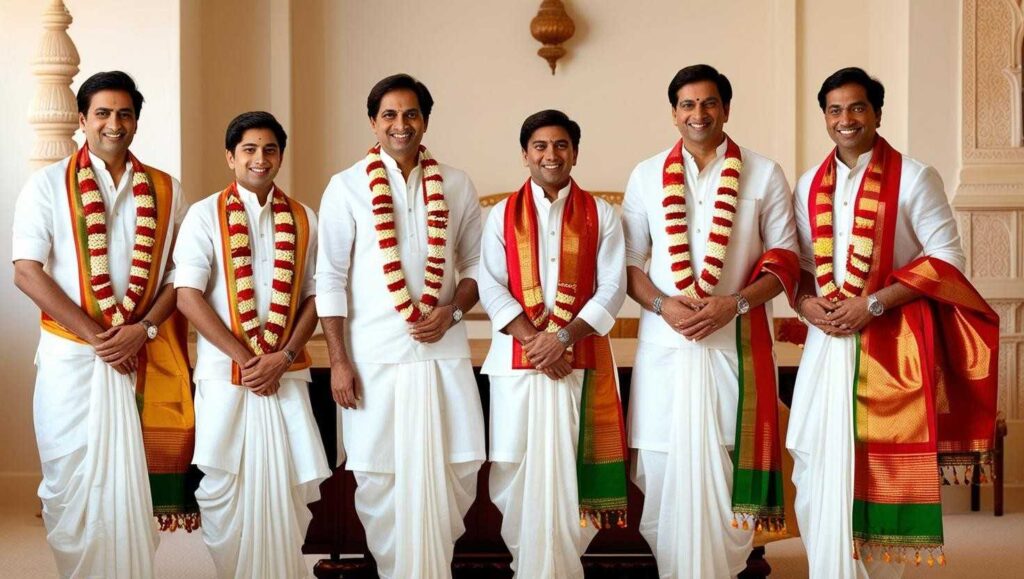
Normally, dhotis are worn during a festival or a marriage ceremony. Especially, in most south Indian weddings, dhoti is an integral part of men’s wear. Almost every politician wears this as his formal wear.
The Art of Draping
Wearing a dhoti is an art in itself.
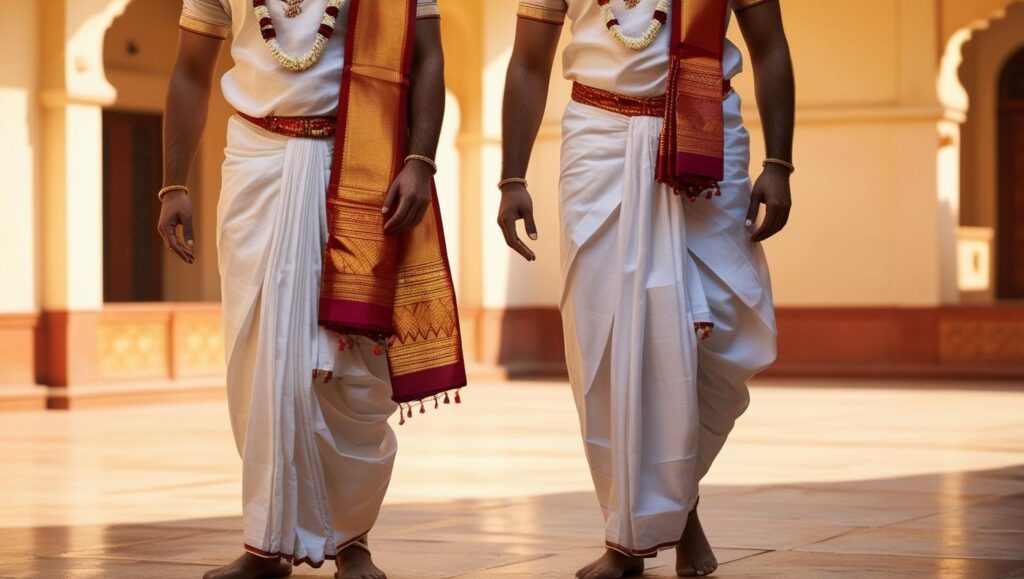
It’s usually 4 to 5 meters long, wrapped around the waist and tucked securely.
The style of draping changes from one region to another —
Tamil Nadu style: Single pleat, elegant and simple.
Andhra style: Double tuck for firm fitting.
Bengali style: Flowing drape with knots.
Each style adds its own cultural story to this timeless garment.
The Fabrics of Tradition
Originally, dhotis were woven from pure cotton — breathable and light.
Over time, silk dhotis became popular for festivals and weddings.
Today, you’ll find cotton, silk, blended, and designer dhotis — yet the essence remains the same: tradition meets comfort.
Dhoti in Modern Times
In today’s world, the dhoti continues to evolve gracefully.
Celebrities, grooms, and cultural icons proudly wear it on stage and screen.
Fashion designers are reintroducing it with a modern twist — dhoti pants, short veshtis, and fusion drapes.
Yet, nothing matches the authentic pride of a traditional dhoti — folded by hand, tied with respect.
The Cultural Significance
In Indian culture, wearing a dhoti is considered auspicious.
It is a mark of humility, respect, and devotion.
During temple rituals, traditional festivals, and weddings, men wear dhotis to honor the divine and uphold custom.
Even today, a white dhoti with a golden zari border stands as a symbol of purity and grace.
Suitability
Dhoti is suited for almost all seasons. The reason is that they are available in both silk and cotton fabrics. The silk varieties are embraced in the traditional customs and marriages, while the cotton ones are worn as daily wear.
Global Influence
It has influenced global culture in many ways. People across the world are wearing dhoti in the pant style and have made it a modern-day style statement.
The Dhoti and Only Omkar
At Only Omkar, we don’t just sell dhotis — we preserve a tradition.
Each dhoti we create carries the craftsmanship of Salem’s weavers, the purity of tradition, and the comfort of natural fabric.
Whether it’s a Cotton Dhoti for daily wear or a Silk Dhoti for grand occasions, each piece tells the story of India’s heritage — woven with devotion.
Final Thoughts
From ancient temples to modern weddings, from rishis to royalty — the dhoti remains eternal.
It’s more than a piece of fabric; it’s a connection to our roots, our pride, and our way of life.
“A dhoti reminds us —
simplicity is the highest form of beauty.”– DineshKumar Subramani